

Curcuma Phase 1: Root System
🇪🇺 Time for Europe to wake up

In my previous edition I wrote about the tectonic shifts happening in community, capital, and the ramifications it holds for European investment in tomorrow's technologies.
Now, you must be wondering, craftsman investing (aka Karigar Investing) is cool and all but what is Curcuma and what am I planning to do with it?
Without further ado, let's get into it.
Context:
Trying to raise a first time fund, with a first time team, almost zero track record and in perhaps the worst fundraising environment for emerging managers in the past 15 years was a great learning experience for me on what it takes to build a fund.
To be fair, it boils down to this: there’s no way you can speedrun building relationships and having prospective investors (LPs) entrust a % of their wealth/allocation in you without them truly getting to know you.
Despite spending months crafting a thesis, reading research papers, diving deep into promising, underrated tech, pitching to hundreds of people, I realised that it always comes down to knowing the right people – and I was starting from scratch.
Barely passing my quarter life crisis at 25 didn’t help me convince anyone either (jokes).
After learning these lessons (and more), I took a step back and tried to analyse the undercurrents of what actually changed since I crafted my original thesis 2.5 years ago.
Three things became crystal clear:
1. The Climate Tech Reality
The days of riding ESG goodwill are over. While the US is ignoring Paris Accords, WHO, NATO, etc. and enterprises will soon squeeze every dollar of profitability through AI automation and agentic employees, you can't rely on moral superiority to pay green premiums.
These technologies need to get competitive, fast – or get toast.
This isn't just another cleantech cycle. As climate solutions intersect with every industry, the game is changing from moral imperative to market necessity.
While classic venture models struggle with the complexity (hello FOAKs & CapEx intensive demonstrators), new frameworks are emerging. It's why you're seeing terms like 'GrowthTech' and 'dynamic resilience' try to replace 'climatetech' in investor vocabularies. (cf. Sifted, Paul Murphy on Twitter, Yair Reem on Linkedin)
2. The Systems View
Community and capital aren't separate forces – together they form a symbiotic organism that grows exponentially under the right conditions, creating a virtuous cycle.
My belief is that these five essential conditions are Patience, Curation, Vulnerability, Cross-pollination and Systems-Thinking.
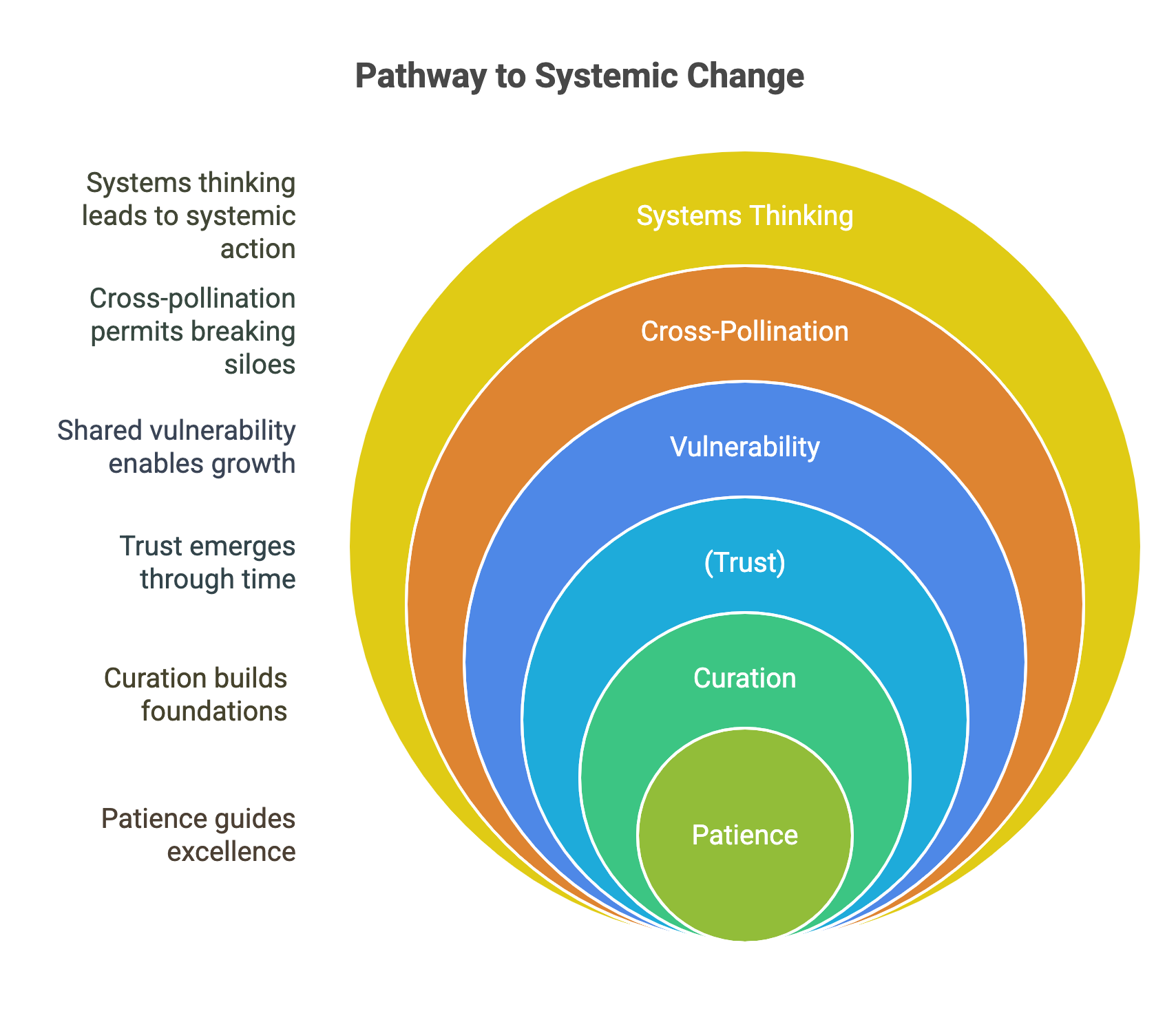
These elements reinforce each other:
Patience lets relationships develop naturally, leading to better curation
Proper curation creates trust
Trust enables vulnerability
Vulnerability enables real cross-pollination
Cross-pollination leads to systems thinking
This virtuous cycle feeds what I call our world's three health bars: human health, planetary health, and societal infrastructure.
Here’s what I mean by these interconnected health bars:
Human health: Beyond curing disease, we need to upgrade human potential itself. A thriving population doesn't just drive economic growth - it enables both planetary stewardship and societal advancement.
Planetary health: We've lost our way as planetary stewards. Regaining symbiosis with nature isn't just environmental - it's existential. Better planet, better lives, better society.
Societal infrastructure: This is civilisation's operating system. Our millenary institutions, be it education, jobs, hospitals, social security - are dying by a thousand cuts. When tech moves in weeks but institutions move in decades, something has to give.
3. Request for European Manhattan Projects
There's a cruel irony in 2025 - the more 'communities' pop up, the less real ambition we see.
Everyone's busy building digital campfires when what we truly need are 1nm chips made in Europe, nuclear fusion reactors, quantum computers, AI champions, cures to cancer and more. We need more ambitious builders thinking trillion-dollar TAMs.
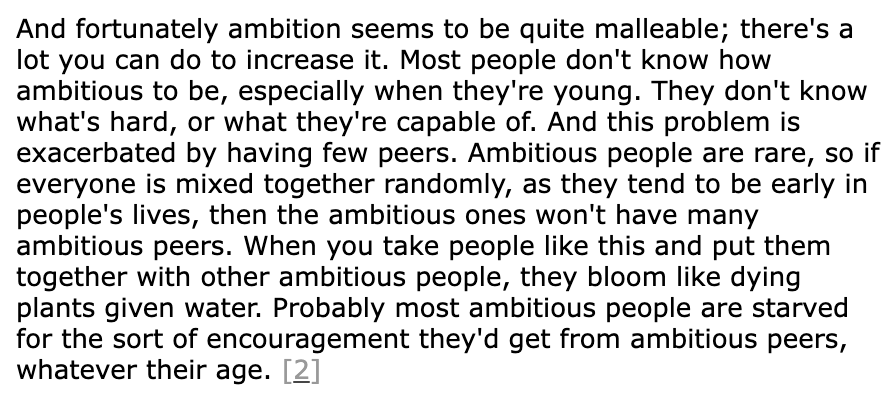
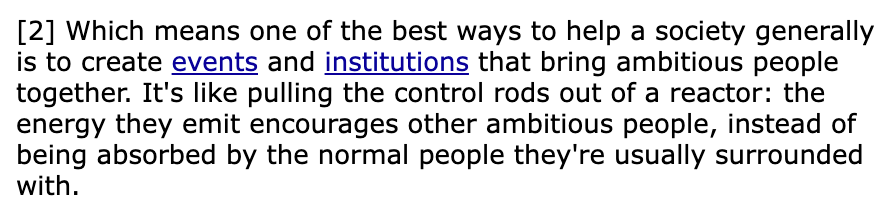
As Paul Graham, co-founder of Y Combinator puts it, when you bring ambitious people together, they 'bloom like dying plants given water.' ‘It's like pulling control rods out of a reactor - the energy they emit encourages others’, instead of being absorbed by the mundane day-to-day.
Without a single trillion-dollar technology company, Europe is missing out on the entire ecosystem that such juggernauts bring. This isn't just about pride - it's about the second-order effects: the experienced operators become investors, the alumni start new ventures, the technical talent builds deep expertise in scaling cutting-edge systems.
The current market offers three paths: get acquired too early (happening too often), scale independently (increasingly difficult), or build something so fundamental it can't be ignored (look at Helsing, Stegra, Verkor). Europe needs more builders choosing that third path.
For that, we need to set aside nationalistic ardour and leverage our geographic integration.
Either we birth our next trillion-dollar companies in the next 25 years or accept our fate as the world's regulatory conscience, forever wagging fingers at actual empire builders.
Culmination:
The Challenge
The old playbooks (2000s-2020s) are dead. Growth hacks that worked for SaaS won't cut it in an age of AI agents and next gen manufacturing. When you're building fusion reactors or defying aging, you need to innovate at breathtaking speed while maintaining unprecedented precision.
This next wave demands both speed and quality - and that requires a new kind of capital. Not just patient money, but deep conviction backing for decade-long moonshots.
Curcuma’s Take
This is where craft venture, patient capital and most importantly, understanding people comes into play. You can't spreadsheet your way to finding the next Demis Hassabis or spot the next Mistral through a LinkedIn scrape.
When someone's in the room with you, you see how they think beyond rehearsed narratives. How deeply they've actually grappled with their domain. Whether their ambition is genuine or just well-packaged behind media-trained talking points.
We're shifting from "attention is all you need" to "taste is all you need"
That's why Phase I of Curcuma is fundamentally IRL. Yes, there is a voluntary bottleneck where I’m the curator of taste. Building out a vision means incarnating its values every single day. You can't delegate this early on.
The Timing
The timing isn't accidental. As AI redistributes human potential, we need spaces where human ingenuity can compound. That's what these agorae are for – connecting the right people at the right moment in history.
That's Curcuma's real end game.
The Architecture
Phase I is all about mastering IRL.
Two formats, zero bullshit: agorae for builders, synaxiae for investors (coming soon).
The agorae follow a simple template: twelve people (Last Supper style), gathered around one problem space. Half are active founders who just started their company, the rest split between future founders and domain experts who've gone deep enough to see what's coming.
Three rules, no exceptions:
I've met you in person
You're building something extraordinary or have the depth to spot what's next
You bring real vulnerability - this isn't about networking
Each gathering is carefully curated. No icebreakers, no LinkedIn connections - just real conversations about what we're building and why.
This is how we build the root system. One conversation, one gathering at a time. Because what's coming next - this Renaissance in technological progress - requires more than capital or conviction.
It requires community.
P.S. If you’ve come this far, thanks a ton for taking the time to read my thoughts, I truly appreciate you being part of this journey from the beginning.
If you know ambitious founders building at the crossroads of sovereignty & frontier technology in Paris, send them my way for the next agora.
Iris Maréchal and Fanny Sauvée are highly committed founders who are heading in the right direction. 😉
How they have deeply grappled with their domain 💙